
Ask a working mum how she “does it all” and she’ll probably laugh, then quietly change the subject. The truth is messier than any productivity hack: mothers carry 71% of the household’s invisible mental load, and that alone can make an ordinary Tuesday feel like juggling two full-time jobs.
But the mums who actually make it through the week aren’t grinding harder or waking up at 5am to “win the day.” They’ve quietly built a handful of small, unglamorous habits that most advice never mentions – and once you see them, you can’t unsee how much they matter.
#11 – The Sunday Night “Brain Dump” That Kills Monday Dread

Most working mums walk into Monday already behind – and it’s not because they didn’t work hard enough on Sunday.
A huge part of the exhaustion is the load no one sees: remembering the dentist appointment, knowing when shoes stop fitting, tracking the field trip money. That tracking is work, even when your hands are still.
One habit that makes a measurable difference is planning tomorrow – or the whole week – before bed. Ten minutes, a running list, a shared app, anything that gets the information out of your head and somewhere you trust.
The women who skip this step don’t sleep any better – they just do their planning anxiously at 2am instead.
But the Sunday brain dump is only the beginning. The real leverage is in what you decide to stop doing – and that’s what #10 is all about.
#10 – Deliberately Dropping the B-Minus Tasks

Here’s the uncomfortable truth most productivity advice won’t say out loud: not everything deserves 100%.
Most things are fine at 80. Giving yourself permission to do a B-minus job on the small stuff buys back hours you can spend on what actually counts – including rest.
Plenty of working mums have tried everything to squeeze in more: waking up earlier, staying up later, multitasking through homework help. On paper it looks productive. In reality, it just leaves you drained and stretched too thin.
Quick Compare
- 100% effort: perfectly folded laundry, from-scratch dinners, zero shortcuts
- 80% effort: clean clothes, dinner on the table, a jarred sauce and nobody minds
- The result: same fed, clothed family – hours of your week handed back to you
The quiet win isn’t doing more – it’s identifying the tasks that were never worth full effort in the first place.
This pairs with something even more counterintuitive, and it’s the habit most mums resist the hardest. Keep reading for #9.
#9 – Hard Stops on Work Emails After Hours

Turns out, the working mums who feel most in control aren’t the ones who reply fastest – they’re the ones who stop replying at a set time.
Building a routine where you refuse to answer work emails or calls after hours is one of the most effective ways to keep a clear line between home and work. It sounds obvious. Most mums still don’t do it.
Work stress affects both sleep quality and relationships with family – two of the things working mums say they most want to protect. The phone going face-down at 6pm isn’t laziness. It’s a system.
Fast Facts
- 76% of employees check work email outside business hours, making the “switched-off evening” the exception, not the norm
- Studies reveal that employees experience increased anxiety, decreased quality of sleep and lower relationship satisfaction because after hours emails promote the constant feeling that a message from work could arrive at any moment
- The negative health effects aren’t limited to the employee – partners of employees experience the same outcomes
Women who enforce this boundary consistently report fewer Sunday-night anxiety spirals – which is when the real cognitive damage of the week tends to pile up.
The next habit on this list feels the most selfish. It’s also, apparently, the most strategic.
#8 – Protecting One Non-Negotiable Slot of Personal Time

Self-care got buried under bubble bath jokes years ago. But the data behind protecting even a small personal time slot is genuinely hard to argue with.
Mums who practice self-care tend to report healthier relationships, lower stress, and higher satisfaction with life overall. We’re not talking spa days – 20 to 30 uninterrupted minutes, a walk, a podcast, a coffee that doesn’t go cold.
As a mum, it’s easy to put everyone else’s needs first, leaving nothing left for your own. But that time isn’t a luxury – it’s maintenance.
The working mums who burn out fastest are almost always the ones who cut their own time first, convinced they’d get back to it once things calmed down. Things don’t calm down.
What actually keeps the week from collapsing, though, is something far less glamorous. It’s #7 – and it lives in the kitchen.
#7 – The Batch Cook That Isn’t Instagram Meal Prep

The perfect grid of matching Tupperware containers? That’s not what’s actually holding the week together for most working mums.
The real version is simpler – pre-cut vegetables, jarred sauces, one big pot of something on Sunday. Pasta sauce, a tray of roasted veg, a batch of rice that turns Tuesday’s dinner into a 10-minute job instead of a 45-minute one.
Working women still average around 2.7 hours a day on household tasks – nearly 19 hours a week of unpaid labour stacked on top of a paying job. Meals are the single biggest time sink in that number.
Batch cooking doesn’t require a recipe – it just requires doing slightly more of something you were already making.
The next habit is the one working mums say they wish they’d started earlier. It has nothing to do with food or schedules – it’s about who you ask for help.
#6 – Building a “Swap Squad” With Other Parents

Most working mums try to solve logistical problems completely alone. The ones who actually get through the week without fraying have quietly built a small network of parents who trade favours.
Teaming up with a neighbour or friend can be a lifesaver – you watch each other’s kids so both of you get a few free hours a week. Carpooling gets easier the moment you start trading driving duties.
Technology has quietly made parenting lonelier, and working mothers are not immune to that isolation. The women managing best aren’t doing it solo – they’ve stopped pretending they should.
Worth Knowing
- About two-thirds of parents say the demands of parenthood sometimes or frequently feel isolating and lonely
- Nearly 4 in 5 parents would value a way to connect with other parents outside of work and home
- Nearly one-third of parents say they lack support from family, friends, or their partner
The biggest obstacle to a swap squad isn’t logistics – it’s the guilt of asking first. Most parents in the same boat are just waiting for someone else to make the first move.
Next up is a habit so small it sounds like it can’t possibly matter. But the research behind #5 will genuinely surprise you.
#5 – The “Anchor Routine” That Saves Mornings

Working mums who describe their weeks as manageable almost always have one thing in common: their mornings don’t start with decisions.
Building regular anchors into your schedule – the same wake time, same first task, same bags-by-the-door routine – gives you structure in the middle of daily chaos without needing fresh willpower every morning.
Leaning on habit instead of decision-making cuts cognitive load and frees up energy for later in the day. Every choice you eliminate at 7am is one you get to keep for something that actually matters.
The mums who reinvent their mornings every single day are the ones who arrive at work already exhausted. The ones with anchors don’t.
The habit at #4 feels uncomfortable at first – and that’s exactly why it works.
#4 – Saying “No” to One Thing Per Week on Purpose

This is the habit working mums describe as the most life-changing – and the one they put off the longest.
Without a clear boundary, the day fills up with distractions and tasks that weren’t even on the radar that morning. You start the day with a plan and end it just reacting.
Many working mothers feel they’re never fully present anywhere – not at work, not at home – no matter how hard they try. A single, guilt-free refusal a week is enough to interrupt that pattern before it hardens.
It doesn’t matter what you say no to. What matters is the act of choosing, deliberately, not to carry one more thing.
And that leads perfectly into #3 – the quiet win that operates almost entirely inside your own head.
#3 – Offloading the Mental Load Into a Shared System

Mothers handle 71% of household mental load tasks on average, and research from the University of Bath confirms this imbalance has real consequences for stress, burnout, and career progress.
The working mums who manage this best don’t carry it better – they’ve moved it out of their heads entirely. One shared family calendar. One running grocery list everyone can add to.
Brain-dumping every recurring task onto one shared app, putting every appointment where everyone can see it, and handing off what others can actually own – that’s mental load reduction in practice, not theory.
The shift isn’t just logistical, it’s psychological. Once the information lives in a system, it stops living rent-free in your brain at 11pm.
But #2 is the habit that’s hardest to talk about – because it means admitting something most working mums don’t want to say out loud.
#2 – Letting Go of the Guilt Audit
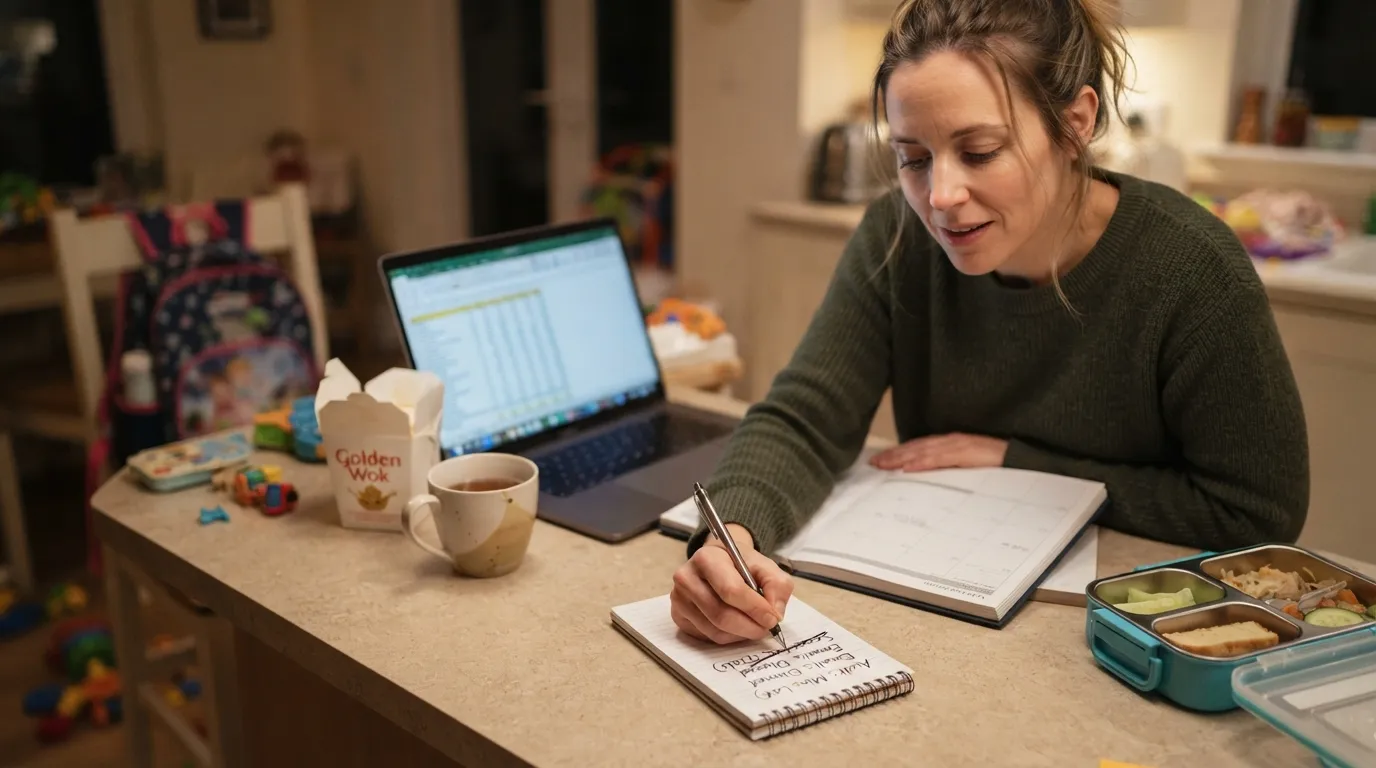
87% of working mums feel guilty. Not some. Not a few. Nearly all of them.
And yet guilt turns out to be one of the most productivity-destroying forces in a working mum’s week. Working mum guilt is the feeling of never quite meeting expectations at work or at home, even when you’re doing your absolute best.
At a Glance: What the Nightly Guilt Audit Usually Targets
- Ordering takeout instead of cooking from scratch
- Missing pickup or a school event because of a work call
- Too much screen time on a chaotic weekday
- Saying no to one more thing, even when it was the right call
The quiet win here isn’t eliminating guilt – it’s refusing to run the nightly mental “audit” where you tally up everything you didn’t do perfectly. That constant internal pressure is what turns ordinary daily tasks into emotional burdens.
The mums who get through the week aren’t the ones who feel less – they’re the ones who’ve stopped prosecuting themselves for being human.
Which brings us to #1. This one is the most practical, the most research-backed, and still somehow the most underestimated habit of all.
#1 – Treating Sleep as a Non-Negotiable Performance Tool

Every working mum knows she’s tired. Almost none of them treat sleep as the actual strategic lever it is.
Nine out of ten people experience problems with their sleep, with one in three experiencing what researchers call “sleep poverty” from environmental stress and workplace demands. That deficit quietly chips away at cognitive function, health, and wellbeing.
Work stress affects sleep, and poor sleep generates more stress the next day – a loop no amount of time management fixes from the outside. The mums who feel capable and present during the week aren’t the ones waking up earliest. They’re the ones protecting 7 to 8 hours as fiercely as a work deadline.
Sleep is not a luxury, it is a biological necessity.
Matthew Walker, sleep scientist
Sleep isn’t recovery from the week – it’s the infrastructure the whole week runs on. Protect it first, and almost everything else becomes more manageable.
Flexible working helps too – women who can work flexibly are less likely to burn out and more likely to stay engaged. But flexibility means nothing if you’re running the week on four hours of broken sleep.
The Bottom Line

Mothers carry 71% of the household mental load, are 28% more likely to burn out than fathers, and 87% carry guilt about it daily. The working mums who actually get through the week aren’t superhuman – they’ve quietly adopted small habits that cut cognitive drain instead of chasing more output.
A Sunday brain dump. A hard stop on emails. A shared system for the mental load. One deliberate “no” a week. And above everything else, sleep, treated as essential infrastructure rather than a luxury.
None of these habits are glamorous. All of them are grounded in real data, and none were found in a productivity app – they were found through necessity.
Which of these do you already do – or which one are you trying first? Drop it in the comments.
Bonus: The One-Page “Family Ops Sheet” No One Talks About

The single highest-leverage habit isn’t on the list above because it’s not really a routine – it’s a document. Working mums who feel least likely to unravel during a crisis all have one thing in common: a single shared page that answers every “who handles this” question before it becomes a panicked phone call.
Build it once in a shared note or doc, and update it in under two minutes a month.
- Backup contacts, in order: list three people (not one) who can do pickup or cover a sick day, with their numbers already saved in your partner’s phone too.
- The “sick day script”: write down exactly which parent covers odd/even days, or which days default to which person, so no one has to negotiate it at 6am while a kid has a fever.
- Non-obvious essentials: shoe size, allergy info, school login, pediatrician number – the stuff a babysitter or grandparent would otherwise have to text you for mid-crisis.
- One shared link, not five apps: put it somewhere both parents (and any regular helper) can open instantly, with edit access, not just view access.
The point isn’t organization for its own sake – it’s removing yourself as the only person who can answer the question. That’s the difference between a bad day and a week that falls apart.